Tim Lockridge
About Reading Archive Also on Micro.blog
  • Introducing Commonplace, an app for readers like me
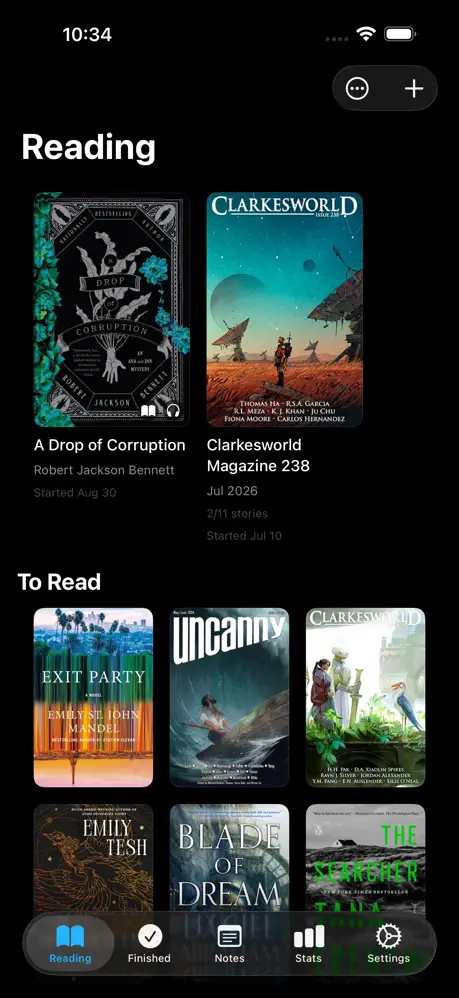
    Screenshot of Commonplace

    For nearly twenty years, I have tracked and taken notes on every novel I’ve read. But the tools for doing this have all been missing something. I’ve moved from paper notebooks to DEVONThink to Day One to Goodreads to Obsidian and a number of smaller apps in between, and each has shortcomings (in this context) that irk me. Last winter, I decided to make Commonplace, which is now available (for free!) on the iOS App Store.

    Commonplace has a few features that I’ve found missing in other apps:

    • Notes. Notes feel like a forgotten part of nearly every book-tracking app I’ve used. Commonplace’s notes are tied to a book or story, marked with the reading phase in which you took them (before, during, after, or re-read), and displayed in their own menu item. The app will also prompt you for a note when you add a book (“How did you hear about this?”). Notes are important.
    • Short fiction. I read Clarkesworld, Uncanny, Lightspeed, Strange Horizons, and Beneath Ceaseless Skies. Commonplace knows about these publications, and it will let you add and track full issues and individual stories from those magazines. You can add star ratings to finished stories, and you can take notes about them. If you log stories, they will appear alongside your finished books. (And if you aren’t a short fiction reader, you’ll only see books in your lists.)
    • Media formats. I read print books, digital books, and audiobooks. I like to note the format(s) in which I’m reading, and Commonplace supports that.
    • Import/Export/iCloud sync. Commonplace can import individual books via its web extension or full catalogs via its csv import. It also exports in json, markdown, and PDF, and it supports the Micro.blog books API, so you can post your Commonplace books to your micro.blog bookshelves.
    • Privacy. No ads, no analytics, no algorithms, no gamification, no nonsense. It’s just a database of books and stories and notes that syncs to your iCloud account. As it should be.

    These are, admittedly, the features that matter most to me, and this is the app I want to use. It may not work for everyone.

    It took me about nine months to get to a viable version 1.0, and I’ve learned a lot along the way. There are many rough edges I’d like to polish, and I’ll continue to iterate on this over time. Book-related APIs are a headache, and this app largely relies on the iTunes & Open Library APIs. Most apps like this (including Micro.blog’s excellent Epilogue) use ISBNdb, but that isn’t free, and I don’t want a significant monthly expense for a hobby project. If the app gains popularity over time I might consider a paid service as an option, but right now I’m relying on free APIs. Those have drawbacks (including coverage), but they contain nearly every novel I’ve read in the past ten years, so they’re good enough for me right now.

    Commonplace is built for my workflows and my preferences, and I don’t see that changing. But I do hope that someone else finds it useful. It’s free on the iOS App Store, and it’s been a great learning sandbox for me.
    → 2:10 PM, Sep 16
    Also on Bluesky
  • The new Lambchop album is the fall soundtrack I needed but didn’t know I needed. Banjo, open space, earnest delivery, surging choir, and a dose of humor when things get too heavy. 🎵

    → 3:41 PM, Aug 27
  • Working with Claude Code: Curriculum Planner

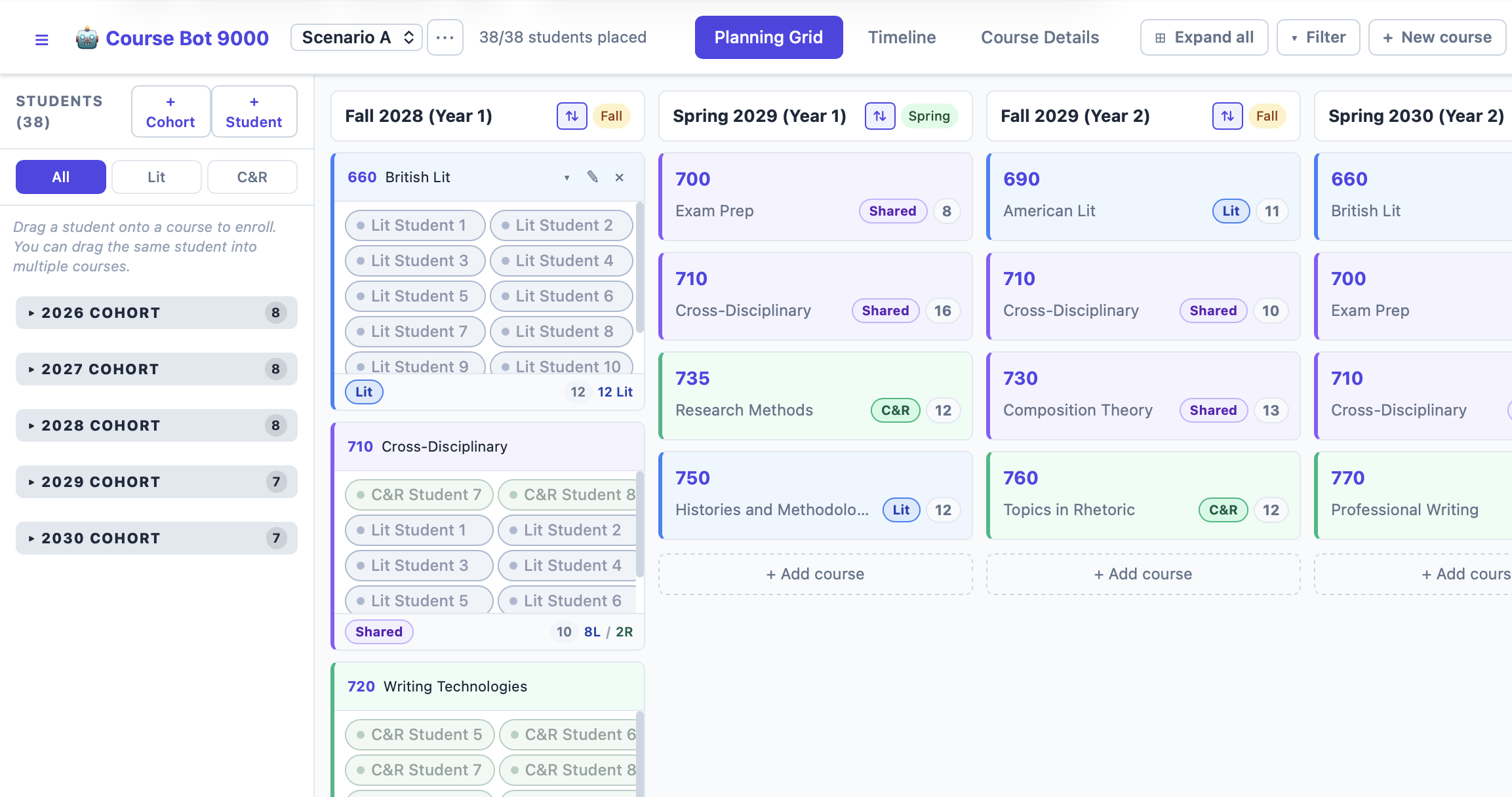
    Like many software enthusiasts, I have been tinkering with Claude Code and building small applications that help me solve a problem. Last week, I created a webapp (using React & Vite) to visualize a graduate curriculum revision. In the world before Claude Code I would have done this in Excel, but I prefer working with webdev tools, and I like to pair these administrative tasks with a new technology. The work is more meaningful if I can learn something along the way.

    The resulting app helped me manage multiple outcomes and variables: the curriculum has to serve disciplinary needs, the courses have to meet minimum enrollment requirements, and—because our graduate students are mostly on assistantships—the whole degree plan has to fit within a student’s awarded years of funding.

    The final app offers a planning grid, a timeline, and a course details view. It also allows me to select any student and see their degree path. I added support for multiple scenarios, and I can compare various curricular proposals and analyze their possible impacts on the program.

    The resulting tool is more user friendly than a spreadsheet but also offers visualizations that have been useful for explaining the curricular changes to others.

    When describing Claude Code to friends, I’ve said that this feels like the most exciting technological change of my lifetime. I can now identify a problem, plan a solution, and—in an afternoon—develop a tool that helps me solve it. I’m sure that my enthusiasm is also shaped by the tool’s nascent era, and my stance on this may change as we move into the world of advertisements and upselling and vulnerabilities, which are sure to follow. But for the moment, I am having a blast.

    A digital interface displays a course planning grid with various courses and cohorts organized by academic terms.
    → 12:45 PM, Mar 26
  • In my morning Readwise email, from Kevin Kelly’s book Excellent Advice for Living:

    When you forgive others they may not notice but you will heal. Forgiveness is not something we do for others; it is a gift to ourselves.

    → 8:49 AM, Mar 11
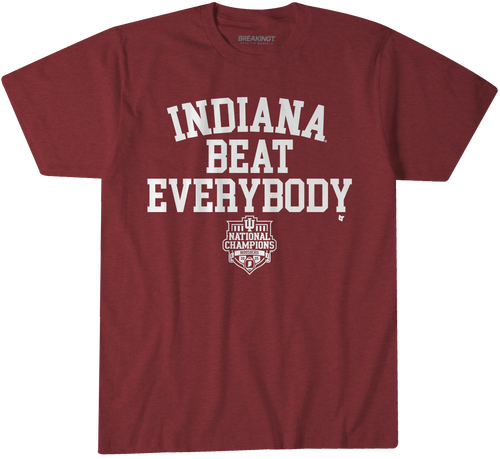
  • It’s been nearly 25 years since I lived in Bloomington, and my sporting allegiances tend to rest elsewhere these days, but watching an undefeated Indiana win the football national championship? I’m going to fondly remember this season. 🏈

    → 1:27 PM, Jan 20
  • Watched: Stranger Things S5E7, Chapter Seven: The Bridge 🍿

    I grew up in Indiana in the 80s & 90s: a nerdy kid who loved D&D and hung out in the mall arcade as a teen and worked at the high school radio station. Stranger Things is potent nostalgia for me. I will miss it.

    → 1:13 PM, Dec 31
  • I often work with soma.fm stations in the background. Groove Salad in the daytime, Folk Forward or Indie Pop Rocks in the evening, Vaporwaves for a change of pace. And December? It’s all Christmas Lounge and Department Store Christmas (no shame!). Soma is one of the Old Internet’s™️ enduring gifts. 🎵

    → 3:17 PM, Dec 4
  • Me: spend weeks carefully curating a playlist for my preschooler, with a mix of excellent kids music (They Might Be Giants, The Laurie Berkner Band, Charlie Hope, Koo Koo) sprinkled with accessible dad rock.

    My son, on the way to school today: Dad, can you play “Who Let the Dogs Out?”

    → 10:18 AM, Nov 4
  • “Day One” has quickly become one of my favorite Bon Iver songs. Top five? Top three? Probably. It’s up there. I also think it’s a Bon Iver litmus test: do the samples and loops and blips work for you? If they don’t, this probably sounds like noise. But if they do, this track is sublime. 🎵

    → 11:41 AM, Oct 7
  • This morning, at my son’s preschool, the kids wear Cincinnati Reds gear. At the gas station, the clerk sees my Reds hat and chats about the lineup. I love the shared and location-specific enthusiasm that comes from a local team’s postseason bid.

    Sadly, we have to play the Dodgers. ⚾️

    → 4:28 PM, Sep 30
  • RSS
  • JSON Feed